Key takeaways
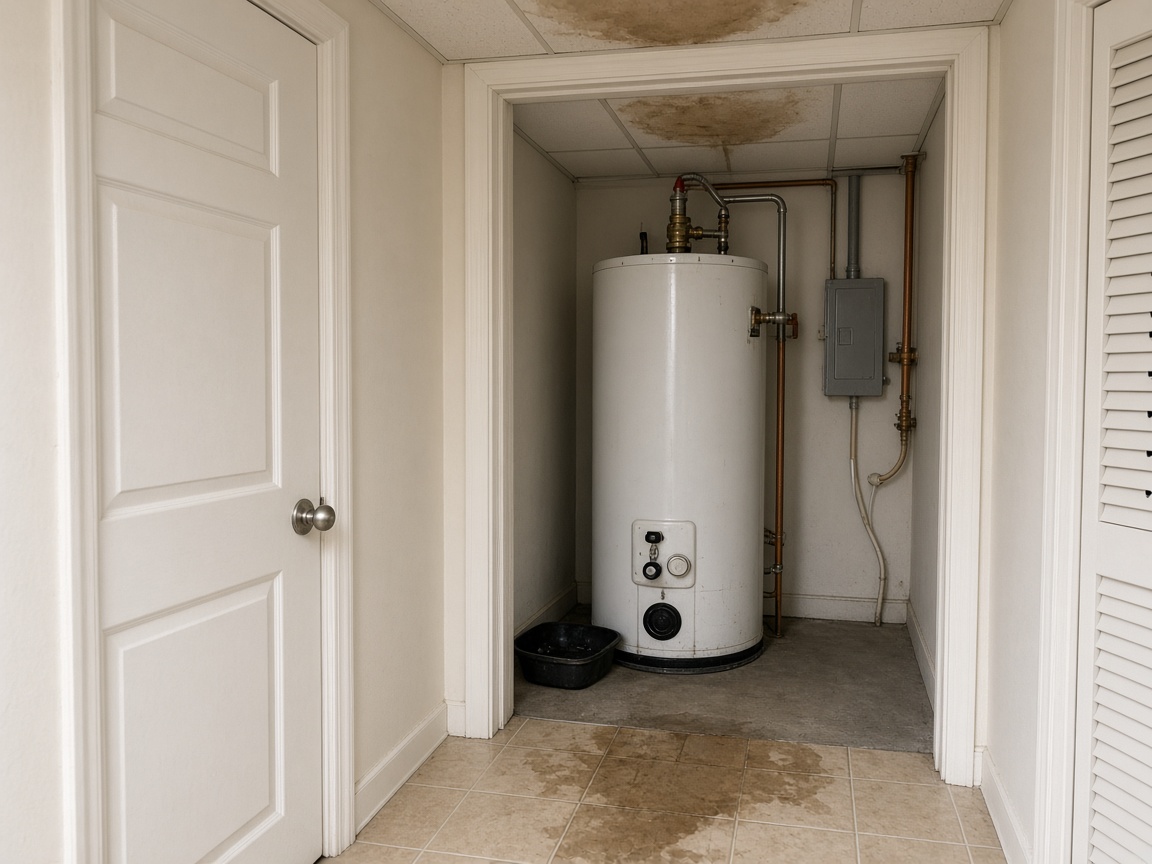
- A pan catches drips. It does not fix the heater.
- If the pan refills, the leak is still active.
- Follow the pan drain. Water at the outside wall means the pan is dumping a real leak.
- A pan that overflows onto a slab will find the hall.
The pan is a bucket with a job
The plastic or metal pan under the heater is there so a drip has a place to sit and, on a good install, a place to leave. It is not a repair.
If you bail it and it fills again, something above it is still leaking. Find that source with the bottom leak checks, or shut the inlet and call.
The leaking water heater visit starts with that question: is the pan the whole story, or is it late to the story?
Full, slow, or dry
| Pan | Meaning | Next step |
|---|---|---|
| Dry, tank jacket damp all over | Often sweat | Wipe and watch one seam |
| An inch of water, comes back | Active leak | Close the inlet if you can |
| Overflowing the lip | The leak beat the drain | Protect the floor, then call |
| Dry pan, water at the outside wall | The drain line already carried it out | The leak is still real |
| Rusty pan, dry today | It has overflowed before | Look at the shell, not just the pan |
A clogged pan line turns a small drip into a closet flood. The clog did not cause the drip.
Where the drain line goes on a slab
On a basement house the pan might drop to a floor drain. Here it should run to a visible outside point or another approved spot, not into a wall cavity.
Walk the outside of the closet wall at Gifford and Florida Ridge houses. A wet streak on the stucco under a small pipe is the pan doing its job.
If there is no drain line at all, the pan holds water until it spills. That is common in older closets. We will say if adding a drain is part of the repair or if the tank has to come out first. See the repair page only when the shell is intact. If you still need the inlet closed, use the shutoff steps first.
When the pan is the least of it
Water over the lip near a bedroom hall is no longer a pan problem. Move people off wet floors near outlets. Ready.gov flood guidance is written for bigger water, and the first move is the same: people, then utilities if you can reach them safely.
A pan that has rusted through under a rusty tank is a replacement. We replace the pan with the heater so the next drip has somewhere to go.
You approve the price after we show you the wet spot and the shell. Bailing the pan overnight will not change that price. It only risks the floor.
A shop vac is fine when the breaker is off and you are standing on dry ground. It is a bad idea when the cord would cross a puddle. Towels in the pan are also a bad idea. They hold water against the tank and hide the level, so you cannot tell if the leak slowed.
We look for a pan drain that was never connected, a drain that loops uphill, and a drain that ends inside a wall. Any of those will overflow a good pan. Fixing the hose is cheap next to a ruined hall, and we will say if that is the whole job.
If the tank above that pan is rotten, the hose is not the whole job. You will see the rust before you approve a replacement. We set the new pan so the next drip has a path you can see outside or at a proper drain.
Check the pan on a normal week, not only when the hall smells wet. An empty pan is the result you want. A pan with a ring of rust and no water today has overflowed before. That ring is a reason to look at the tank, not a reason to paint the pan and forget it.
Condensate from a nearby air handler can land in the same pan and fool you. If the heater jacket is dry and the pan fills only when the air conditioner runs, tell us. We will not replace a heater that is not leaking. The hose from the air handler is the other trade, and we will say so.
Keep a small gap around the pan so you can see the lip. Stored boxes drink the overflow and delay the moment you notice. The pan only helps if someone can see that it is winning or losing.
If the pan drain daylights in a flower bed, look there before you assume the closet is dry. A bed that is suddenly soggy, with the hose bib off, is often the pan telling on the heater. Ants and mulch will hide that spot. Pull the mulch back once and see if the pipe end is wet.
A pan that is the wrong size, smaller than the tank, catches nothing. We see those under heaters that were swapped without the pan being swapped. Water misses the pan and wets the slab while the pan stays clean and empty. Empty is not proof. The floor around the pan is the proof.
Water on the floor?
Call with the street and the fuel type. You approve the price before we start.
Call (772) 555-0140Questions
Can I drill a hole in the pan so it stops overflowing?
Not through the floor, and not into a wall. A random hole dumps water where you cannot see it. If the pan has no drain, call. We route it on purpose or we change the heater. A hole you drill becomes a leak you cannot point to later.
The pan is full but I cannot find a drip. Is that possible?
Yes. The jacket hides the start. Wipe, watch, and do not assume sweat if the pan is filling. Sweat rarely fills a pan to the lip. The jacket hides the first inch of a leak. A full pan means keep looking, or have us look.
Should the pan be full of water all the time?
No. A working pan is empty, or it drains as fast as a small drip arrives. Standing water means a leak, a clogged drain, or both. Empty and dry is the normal pan. Anything else is a leak, a clog, or both.
Do you replace the pan if the tank is fine?
If the pan is cracked or rusted out and the tank is sound, the pan can be its own repair. We will not lift a sound tank out just to sell a heater. A cracked pan under a sound tank is worth changing. A sound tank is not a sales lead.
Sources
Need help now?
Want this heater looked at?
Have the street ready. You approve the price before we start.